Intro
Introduction
Why the businesses that stop growing all share one thing in common and what it means for yours right now.
The operators who see it coming build empires. The ones who don't become case studies.
Every business that stopped growing had a playbook that used to work. This book is about what you do when you sense yours is running out of road.
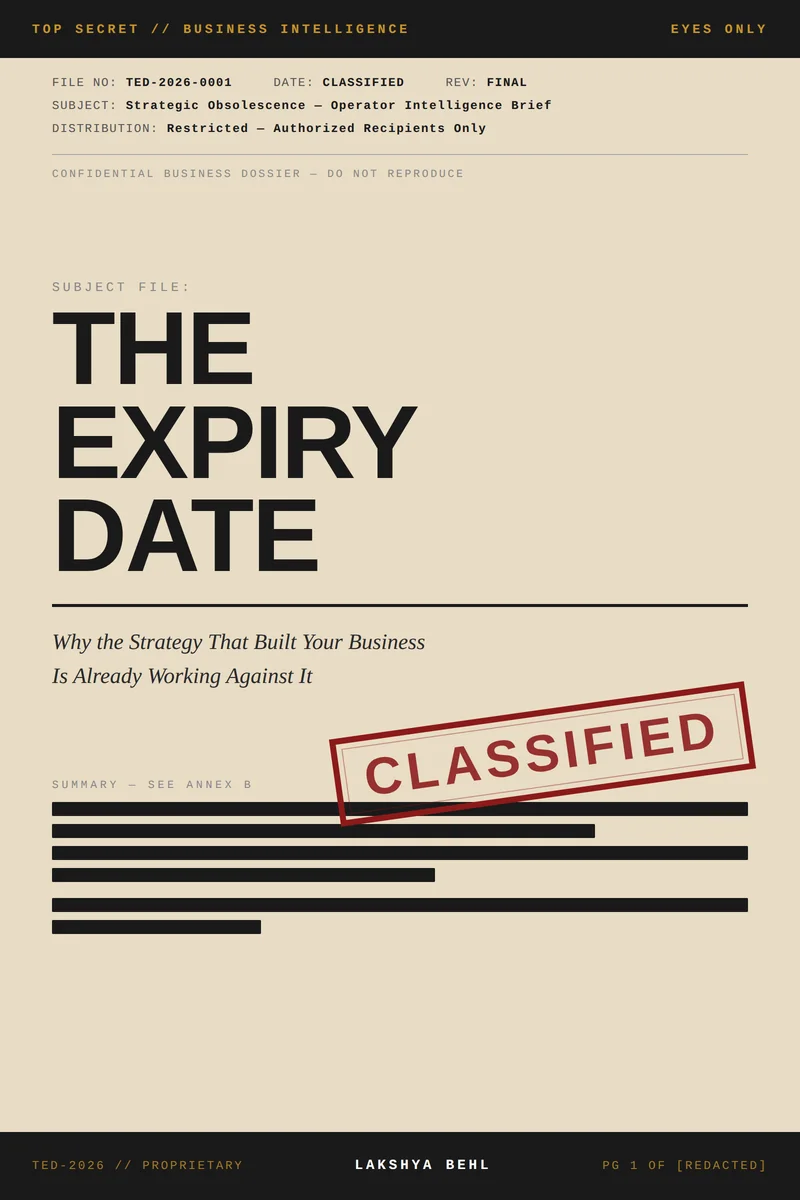
You built something real. You found a way to win a sales approach, a positioning, a delivery model that set you apart. You worked that edge for years. Maybe decades. And it worked. Revenue climbed, margins held, customers returned. But somewhere in the last two or three years, something shifted. The pipeline feels harder to fill. The deals that used to close themselves now require more explanation. Competitors who had no right to exist are eating margin you once considered untouchable. The playbook is still running. But it's running slower.
This is not a market downturn. It is not a staffing problem. It is not a marketing problem you can spend your way out of. It is something more structural: the strategy that made you successful has passed its expiry date. Markets saturate. Customer expectations move. What once made you distinctive becomes baseline table stakes every competitor now meets. Competitive commoditisation is not a sudden event; it is a slow erosion that most operators fail to see until the damage is already done, because the lagging indicators of revenue and profit take eighteen to twenty-four months to show what the leading indicators have been signalling for years.
The operators who build lasting businesses are not the ones who find the right strategy and execute it perfectly. They are the ones who know when a strategy is expiring and who have already started building the next one before the current one fails. They treat strategy as a renewable resource, not a permanent asset. They stay close enough to their customers, their market, and their own assumptions to recognise when the ground is shifting beneath their feet.
The Expiry Date is the distillation of that pattern, drawn from hundreds of businesses across dozens of industries the ones that stayed sharp and the ones that quietly disappeared. It is not a crisis manual. It is a thinking framework for operators who are still winning but feel, in their gut, that the rules of the game are changing around them. Read it before you need it.
Each chapter addresses a specific strategic failure mode. The complete arc moves from awareness to positioning to growth to defence the full operating cycle of a business that intends to stay relevant.
Why the businesses that stop growing all share one thing in common and what it means for yours right now.
How every competitive advantage has a natural lifespan and how to measure how much time yours has left.
The cognitive biases that make successful operators the last to see their own model decaying.
Why the right moment to reinvent is always earlier than it feels, and how to move before the urgency hits.
How the most effective operators separate identity from strategy and pivot without losing credibility.
The market tells you what it will buy. The operator's job is to listen accurately and position accordingly.
How to build a structured experimentation process that generates strategic signal rather than noise.
Attention is finite and increasingly expensive the operators who earn it consistently follow different rules.
Why credibility must come before promotion and how to sequence the two for maximum commercial effect.
Identifying the customer segment that drives outsized revenue, referrals, and longevity and doubling down on it.
Positioning clarity is a commercial weapon. How to distil what you do into language that makes buyers choose you over everyone else.
The sales aversion that costs operators millions and the reframe that makes selling feel like service.
Trust is not built over time it is built through specific sequences of action. The anatomy of fast, durable trust in commercial relationships.
Large-ticket sales follow a different logic. The five principles that experienced operators use to close high-value, high-stakes work.
Acquiring clients is easy compared to retaining them. How to diagnose and fix the retention gaps that are quietly draining your growth.
The system-building mindset that separates scalable businesses from high-income self-employment and how to cross that line.
The resilience test every founder eventually faces and how to build operations that don't depend on you being in the room.
The structural discipline that keeps growing businesses from becoming slow, bloated, and vulnerable to leaner competitors.
What makes a business genuinely acquirable and why engineering for exit value is also the blueprint for a better-run business today.
Capital allocation decisions made in good times determine resilience in bad ones. The discipline of deploying cash deliberately rather than reactively.
Time arbitrage how the best operators protect and direct their attention in ways that compound over years.
Competitive strategy that avoids head-on attrition the positioning moves that let you win market share without a price war.
The discipline of strategic exits clients, partnerships, markets, and models that are costing you more than they return.
The one question that ties all 22 lessons together and why the answer changes everything about how you run tomorrow's meeting.
You have built real revenue. You have a real team. You have solved hard problems before and you will solve them again. But something has shifted in the last year or two a flatness in the pipeline, a new competitor behaving in ways that make no economic sense, a client conversation that would have been a closed deal eighteen months ago but isn't anymore.
This is not a startup manual. It is not an inspiration book. There are no rags-to-riches narratives, no hustle culture rallying cries, and no frameworks designed for someone who hasn't built a business yet. If that is what you are looking for, this book will disappoint you.
Under $30 for a paperback that could change how you think about the next decade of your business.
The standard trade paperback. Clean, readable, portable. Read it on a plane, annotate the margins, leave it on your desk. This is the format most operators will work through first.
ISBN 9798197316141
Buy Paperback →The shelf copy. Built to last. For the operators who keep their reference books within reach. Buy it for yourself, or give it to the founder on your team who is running a strategy that stopped working six months ago and hasn't admitted it yet.
ISBN 9798197353900
Buy Hardcover →Read it anywhere, immediately. No waiting, no shipping. The Kindle edition is ideal if you want to get started today and decide on a print copy later.
Kindle Edition
Get on Kindle →Lakshya Behl is the founder of Westernston Inc., a strategy and operational systems consultancy that works with established, privately held businesses in the $1M to $200M revenue range. He has spent the better part of a decade embedded in real businesses not advising from the outside, but building, restructuring, and systematising from within. The work has taken him across industries: professional services, manufacturing, distribution, high-ticket retail, and complex B2B environments.
The pattern that became this book emerged from that work. Across hundreds of engagements, the same shape kept appearing: a business that was once sharp, differentiated, and growing had gradually stopped seeing its own blind spots. The strategy that built the business had become the wall around it. The operators who broke through were the ones who learned to treat their own assumptions as hypotheses rather than facts. The ones who didn't became cautionary tales.
The Expiry Date is Lakshya's attempt to make that pattern legible to give serious operators a vocabulary for something they already feel in their gut but may not have language for yet. It is written in the direct, system-level language that practitioners use, not the inspirational register of the business-book genre. There are no anecdotes about famous CEOs. There are frameworks, diagnostics, and a sequence of thinking that operators can apply to their own business the same week they read it.
Lakshya works globally, thinks in systems, and writes in plain language. He consults exclusively with businesses that meet Westernston's eligibility criteria established revenue, genuine differentiation, and a decision-maker with full authority to act.

Available now in paperback, hardcover, and Kindle on Amazon. The strategies inside were built for operators running real businesses not hypothetical ones.
Need hands-on strategic help for your business? See our consulting programs.